By Sumanth Kumar Garakarajula, Advocate
The legal profession has always evolved alongside society. From handwritten pleadings to typewriters, from law reports to online databases, every technological shift has altered how advocates work—but never what advocacy fundamentally is. Today, Artificial Intelligence (AI) marks another such shift. It promises speed, efficiency, and analytical power unimaginable a decade ago. Yet, amid this excitement and anxiety, one truth deserves emphasis: the future of law lies not in replacing advocates with machines, but in AI-augmented advocacy where the human element remains central.
AI has already entered courtrooms indirectly. Legal research platforms use machine learning to fetch judgments within seconds. Drafting tools assist in structuring pleadings and contracts. Predictive analytics claim to estimate case timelines and outcomes. For overworked advocates handling multiple briefs, these tools can be invaluable. They reduce time spent on repetitive, mechanical tasks and allow lawyers to focus on core legal reasoning.
However, law is not a factory process. It is not merely about retrieving precedents or applying formulas. Law deals with human disputes, social conflicts, moral dilemmas, and constitutional values. Behind every case file is a human story—of loss, injustice, fear, or aspiration. No algorithm, however advanced, can fully understand these dimensions.
An advocate’s role extends far beyond information processing. Advocacy involves judgment, discretion, empathy, and ethical responsibility. It requires reading between the lines—understanding not just what is stated in affidavits, but what is omitted; not just the letter of the law, but its spirit. AI may identify patterns in past judgments, but it cannot grasp evolving social realities or the lived experiences of litigants.
Courtroom advocacy, in particular, remains deeply human. Cross-examination is not a data exercise; it is an art. It depends on instinct, observation, timing, and emotional intelligence. A seasoned advocate senses hesitation in a witness, reads the mood of the court, and adapts arguments in real time. These skills are shaped by experience, not code.
There is also the question of accountability. Law is a profession governed by ethics and responsibility. An advocate answers to the client, the court, and society. If an AI-generated draft contains an error or bias, responsibility still rests on the human lawyer who relied on it. Delegating thinking entirely to machines risks diluting professional accountability and undermining public trust in the justice system.
The concern, therefore, is not that AI will replace advocates overnight, but that uncritical dependence on AI may weaken independent legal thinking. If lawyers begin to accept algorithmic outputs as unquestionable truth, advocacy risks becoming mechanical and homogenized. Legal reasoning thrives on dissent, creativity, and interpretation—qualities that flourish only when the human mind remains engaged.
In the Indian context, this concern becomes even more significant. India’s legal system operates within extraordinary diversity—linguistic, cultural, economic, and social. Many disputes cannot be understood without sensitivity to local realities. Constitutional litigation, public interest cases, and criminal trials often involve questions of social justice, equity, and morality that go beyond precedents alone. AI trained on past data may reflect existing biases rather than challenge them.
At the same time, rejecting AI altogether would be unrealistic and counterproductive. When used responsibly, AI can democratize access to legal resources, assist young advocates, and reduce inefficiencies. It can help bridge the gap between legal demand and limited professional capacity. The challenge is to integrate AI as a tool, not as a decision-maker.
The concept of the AI-augmented advocate captures this balance. In this model, AI functions like an intelligent junior—fast, tireless, and analytical—while the advocate retains control over strategy, interpretation, and ethical judgment. AI may suggest, but the advocate decides. AI may analyze, but the advocate understands.
Legal education and professional training must adapt accordingly. Future advocates must be taught not only how to use AI tools, but how to question them. Critical thinking, constitutional values, and ethical reasoning must remain at the heart of legal practice. Technology should sharpen the lawyer’s mind, not replace it.
Judges, too, rely on advocacy to assist the court in arriving at just outcomes. Courts do not merely seek correct answers; they seek fair ones. That fairness emerges from human reasoning informed by law, not automated predictions.
Ultimately, justice is a human pursuit. It reflects society’s conscience at a given moment in time. Machines can process law, but they cannot believe in justice. They do not feel the weight of liberty, the pain of injustice, or the responsibility of power.
As AI becomes more sophisticated, the legal profession must resist the temptation to equate intelligence with humanity. The strength of advocacy has always rested on the advocate’s ability to think independently, argue courageously, and act ethically.
The future, therefore, belongs not to the AI-driven lawyer, but to the AI-assisted, human-led advocate—one who embraces technology without surrendering judgment, who values efficiency without sacrificing empathy, and who remembers that while machines may aid the process, justice itself remains profoundly human.
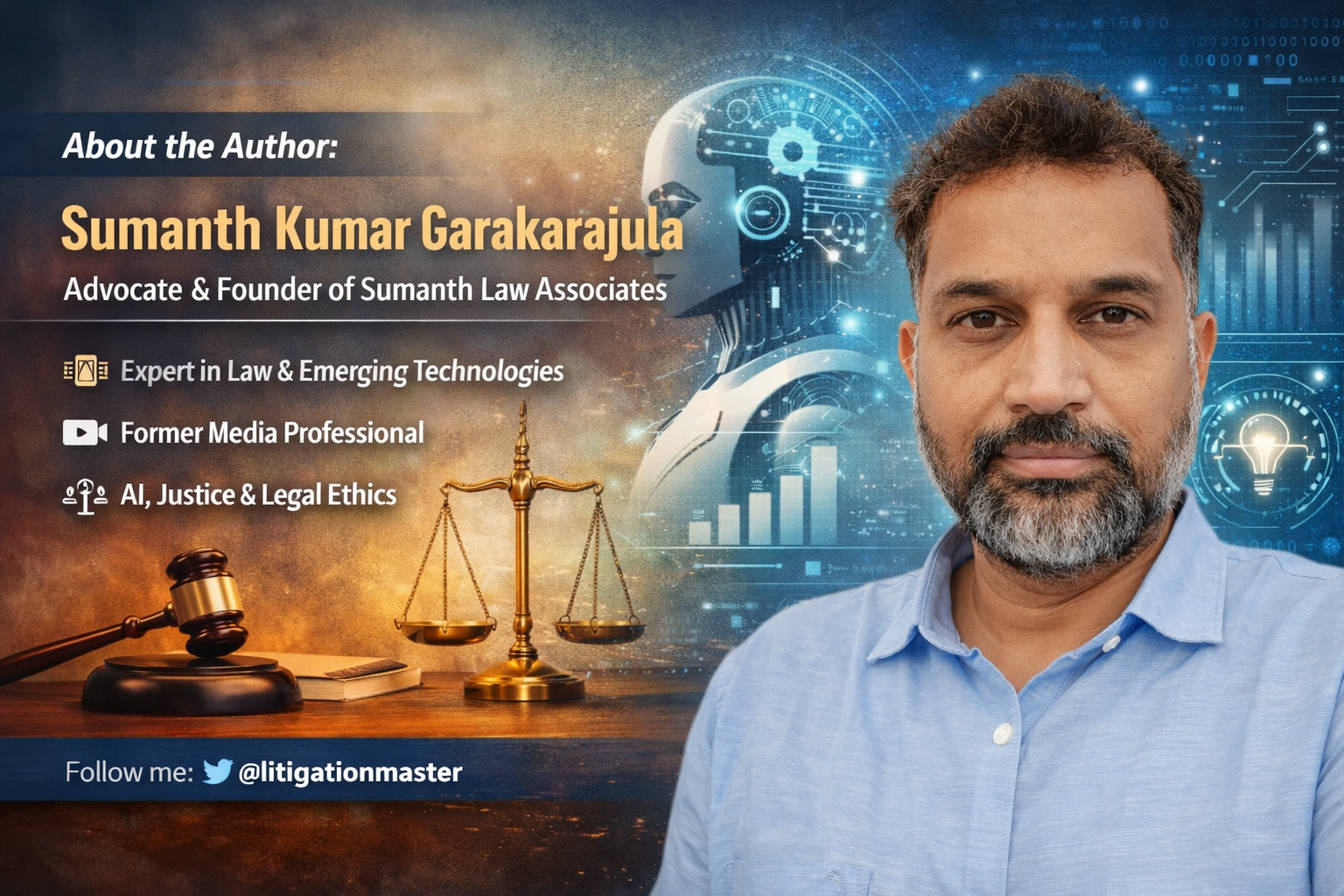
About the Author:
Sumanth Kumar Garakarajula is an Advocate and the founder of Sumanth Law Associates, with a strong interest in the intersection of law and emerging technologies. A former media professional, he actively engages in discussions on AI, justice, and legal ethics. He shares legal insights and public awareness content through his social media handle @litigationmaster.