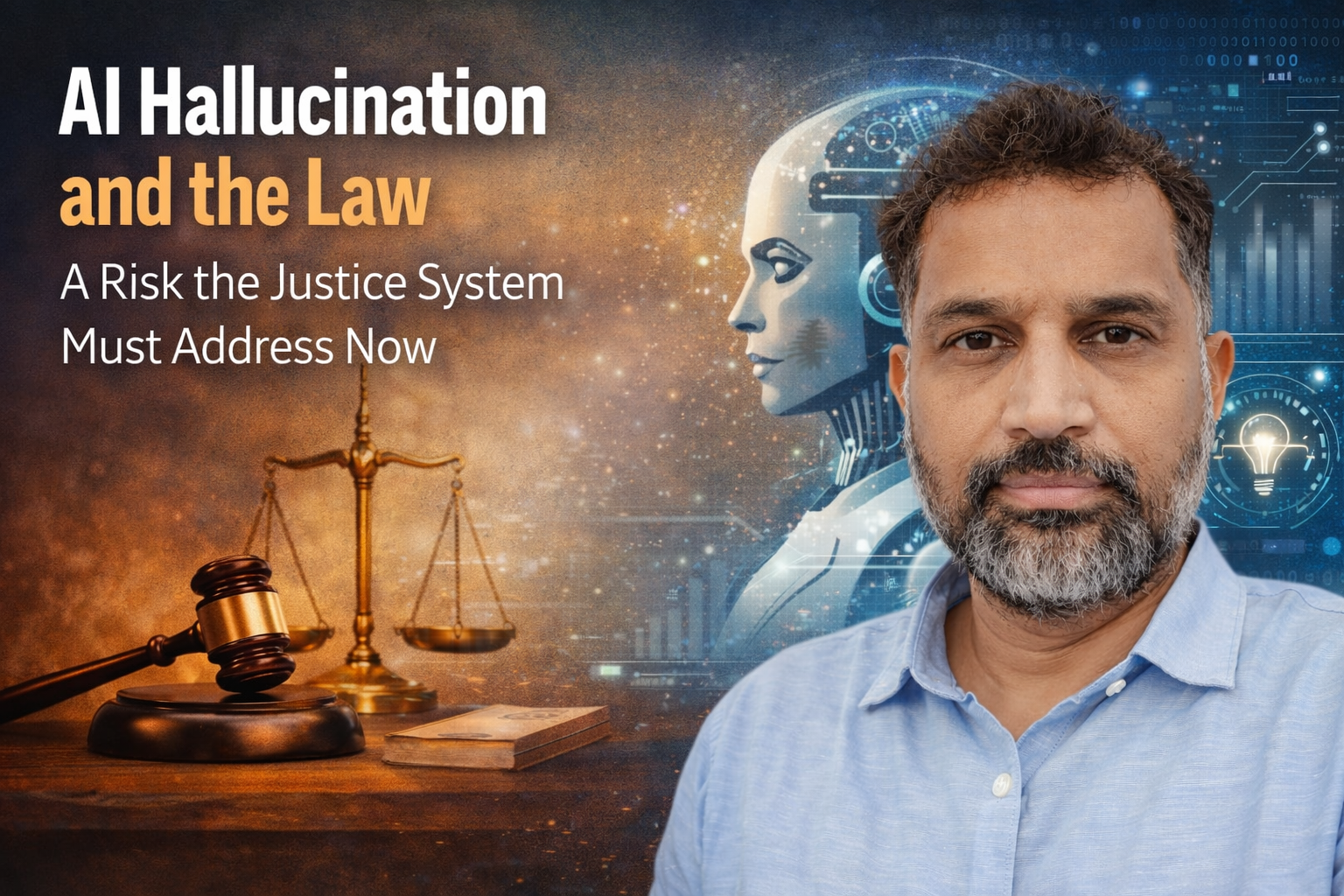
Artificial Intelligence (AI) is rapidly becoming a part of legal practice. From legal research and drafting to compliance checks and case analysis, AI tools are increasingly being used by advocates, law firms, and institutions. While AI promises speed and efficiency, it also brings with it a serious and often overlooked danger—AI hallucination.
In the legal context, hallucination is not a minor technical error. It is a systemic risk that can directly affect justice delivery, professional ethics, and the credibility of the legal system itself.
What Is AI Hallucination?
AI hallucination refers to a situation where an AI system generates content that appears confident, logical, and well-structured, but is factually incorrect, partially fabricated, or entirely false. In legal usage, this may include:
- Citing judgments that do not exist
- Attributing incorrect observations to constitutional courts
- Misquoting statutory provisions
- Inventing legal principles that appear settled but are not
The most dangerous aspect of hallucination is that it does not look like an error. The output often sounds authoritative, making it difficult for users—especially young lawyers—to immediately detect inaccuracies.
Why Hallucination Is Especially Dangerous in Law
Law is a discipline where precision is fundamental. Courts rely on advocates to place accurate law and verified facts on record. When AI-generated hallucinations enter legal pleadings or opinions, the consequences can be severe.
Unlike other professions, legal errors do not remain confined to internal processes. They directly affect litigants’ rights, judicial reasoning, and public confidence in justice institutions.
Impact on the Legal System
1. Erosion of Judicial Trust
Judges depend on advocates as officers of the court. Repeated submission of incorrect or fabricated authorities—whether intentional or AI-assisted—can weaken that trust.
2. Professional Liability
An advocate remains fully responsible for every document filed before a court. Reliance on AI does not dilute professional accountability. Hallucinated citations may amount to negligence or misconduct.
3. Increased Judicial Burden
Courts already operate under heavy caseloads. Time spent verifying incorrect AI-generated citations delays justice and burdens the judiciary unnecessarily.
4. Risk of Systemic Bias
AI systems often reflect biases present in their training data. Hallucinations can reinforce outdated, unconstitutional, or inequitable interpretations of law.
5. Threat to the Rule of Law
Consistency, predictability, and reliability are pillars of the rule of law. Widespread circulation of false legal information undermines all three.
Why AI Hallucinates
AI does not “understand” law. It predicts language based on probability, not truth. When faced with ambiguous prompts or complex legal questions, it may attempt to fill gaps by generating plausible-sounding—but incorrect—answers.
Unless specifically restricted to verified databases, AI models do not independently validate legal sources.
What Needs to Be Done
1. Human Oversight Must Be Mandatory
AI should function only as an assistive tool. Every AI-generated legal output must be independently verified by a qualified advocate.
2. Clear Regulatory Guidelines
Bar Councils and judicial bodies must issue clear norms governing AI usage in legal drafting, research, and submissions.
3. AI Literacy in the Legal Profession
Advocates and judges must be trained not just to use AI tools, but to understand their limitations and risks.
4. Domain-Specific Legal AI
Legal AI tools must be trained on authenticated databases and restricted from generating unverifiable citations.
5. Accountability Must Remain Human
No matter how advanced AI becomes, responsibility for legal errors must always rest with the human professional.
AI hallucination is not a future concern—it is a present and real risk. In law, where liberty, property, and constitutional rights are at stake, accuracy is justice.
AI can assist advocates, but it cannot replace legal reasoning, ethical judgment, or accountability. The legal system must adopt AI cautiously, responsibly, and constitutionally—ensuring that technology strengthens justice rather than distorting it.
The future belongs not to AI-driven lawyering, but to human-led advocacy, responsibly augmented by technology.
About the Author
Sumanth Kumar Garakarajula is an Advocate and Founder of Sumanth Law Associates, with a focused interest in the intersection of law and emerging technologies. A former media professional, he actively writes and speaks on AI, justice, and legal ethics. He shares legal awareness and analysis through his social media handle @litigationmasterand in X.com @litigationmastr.