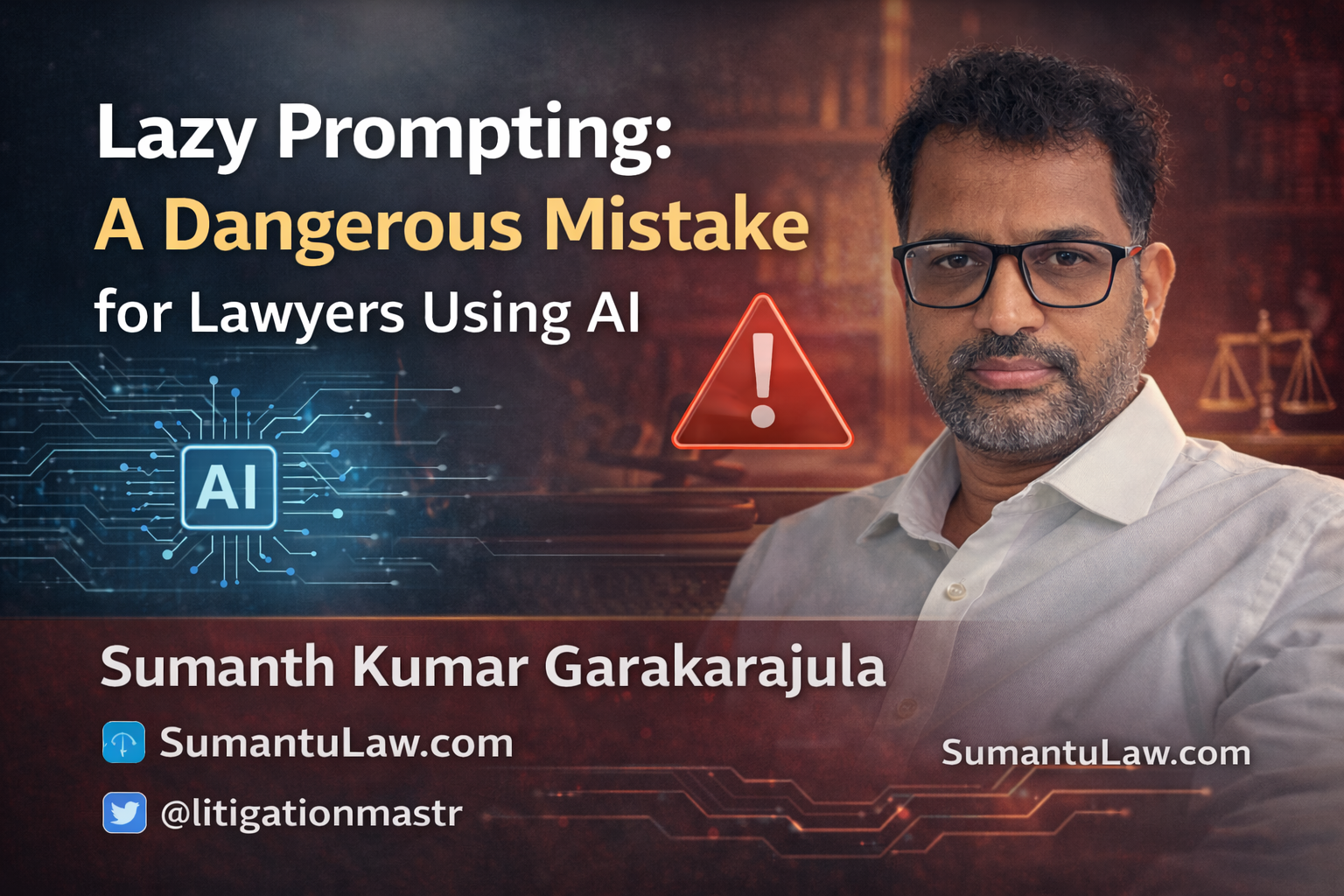
Artificial intelligence is now widely used by lawyers for research, drafting, and case preparation. While this has improved speed and access to information, it has also introduced a new professional risk—lazy prompting. Lazy prompting may appear harmless, but for lawyers it can be dangerous, misleading, and professionally costly.
Lazy prompting happens when a lawyer asks an AI tool a vague, rushed, or incomplete question and accepts the answer without sufficient scrutiny. It is the digital equivalent of skimming a judgment or relying on a headnote without reading the full decision. In law, this approach has always been risky. With AI, the risk is multiplied.
AI responds to the quality of the input it receives. When a lawyer uses broad prompts such as “give me case law on bail” or “draft a petition on cheating,” the AI fills in the gaps on its own. It may rely on assumptions, mix jurisdictions, or generalise legal principles. The result often sounds confident but lacks precision, relevance, or accuracy.
One of the biggest dangers of lazy prompting is incomplete legal research. A loosely framed prompt may cause the AI to miss binding precedents, overlook recent developments, or ignore statutory nuances. In Indian legal practice, where outcomes often depend on jurisdiction, bench strength, and factual distinctions, this can seriously weaken a case.
Lazy prompting is equally hazardous in legal drafting. When AI is asked to draft pleadings without clear instructions on facts, relief sought, or legal provisions, the output tends to be generic. Such drafts may appear polished but lack substance. They often miss essential pleadings, fail to address necessary legal ingredients, or omit crucial averments. This creates a real risk of pleadings being challenged for vagueness or incompleteness.
Courts, including the Supreme Court of India, have consistently emphasised that pleadings must be precise, complete, and supported by material facts. Lazy prompting encourages the opposite—surface-level drafting that looks acceptable but collapses under judicial scrutiny.
Another danger lies in false confidence. AI-generated responses are usually well-worded. This can mislead lawyers into believing the output is reliable even when it is not. Lazy prompting increases the likelihood of fabricated citations, misquoted judgments, or oversimplified legal reasoning. When such errors enter pleadings or submissions, the responsibility lies entirely with the lawyer, not the technology.
From an ethical standpoint, lazy prompting undermines professional diligence. Lawyers are expected to apply independent judgment, verify sources, and ensure completeness. Delegating this responsibility to AI through careless prompts risks breaching these duties. Technology is meant to assist legal thinking, not replace it.
Lazy prompting also affects long-term skill development. Lawyers who rely on shallow AI interactions risk weakening their own research and drafting abilities. Over time, this can erode legal intuition and analytical depth—qualities that distinguish effective advocates from average ones.
The solution is not to avoid AI, but to use it responsibly. Thoughtful prompting requires clarity, structure, and legal context. It demands the same discipline lawyers already apply to drafting notices, pleadings, and opinions. Careful prompts lead to focused outputs, which are easier to verify and refine.
AI rewards effort. The more precise the question, the more reliable the response. Lazy prompting does the opposite—it invites error while creating an illusion of efficiency.
For lawyers, the message is simple. Speed must never come at the cost of thoroughness. In law, incomplete research and weak pleadings do real damage. Lazy prompting turns a powerful tool into a liability.
The future of legal practice will belong to those who combine technological efficiency with professional rigor. Lazy prompting has no place in that future.
Author
Sumanth Kumar Garakarajula
Founder, Sumantu Law Associates
Advocate | Litigator
Former Media Professional
AI & Law Policy Enthusiast
Website: SumantuLaw.com
YouTube: @litigationmaster
X (Twitter): @litigationmast