Artificial intelligence has quietly become part of a lawyer’s everyday work. Legal research, drafting, summarising judgments, preparing notes—tasks that once took hours are now completed in minutes. As more AI tools enter the market, lawyers are faced with a practical but important question: Which AI should I actually be using?
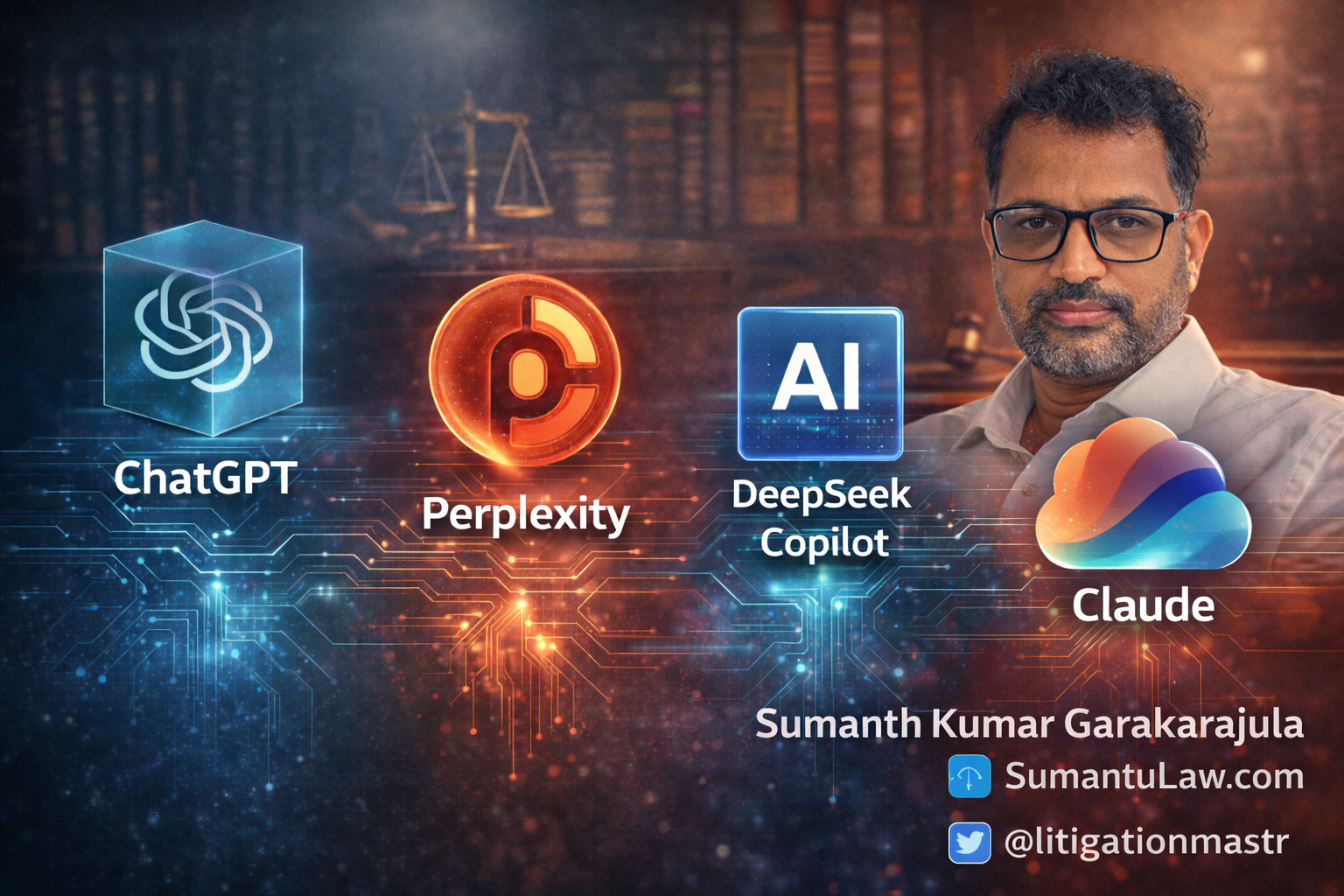
Names like ChatGPT, Perplexity, DeepSeek Copilot, and Claude are often mentioned in the same breath. Each promises smarter answers, faster research, and better productivity. Yet lawyers who experiment with these tools quickly realise that the experience varies widely. Some tools feel intuitive. Others feel precise. A few feel cautious. None feel identical.
For lawyers, the stakes are higher than for most professionals. Legal work demands accuracy, context, and accountability. A wrong citation, a misleading summary, or an incomplete analysis can have serious consequences. So the question is not simply which AI sounds impressive, but which one actually fits legal work.
ChatGPT is often the first tool lawyers encounter. It feels conversational and flexible. It responds quickly, explains concepts clearly, and drafts text that reads naturally. Many lawyers use it to structure arguments, simplify complex issues, or prepare first drafts. At the same time, experienced users notice that it needs careful handling. Without precise instructions, it can generalise, assume facts, or confidently state something that needs verification.
Perplexity creates a very different impression. It is less conversational and more focused on answers. It often presents responses with sources, which immediately appeals to lawyers trained to ask, “Where is this coming from?” For research-heavy tasks, especially where quick verification matters, this approach feels reassuring. But when lawyers try to use it for detailed drafting or nuanced argument-building, its limitations become visible.
DeepSeek Copilot enters the picture more quietly. It works best when lawyers are already inside documents—contracts, notes, emails, or case files. Rather than answering broad questions, it assists within an existing workflow. It highlights, summarises, and reorganises. For lawyers dealing with volumes of text, this kind of assistance can feel practical rather than impressive.
Claude has its own personality. It appears more restrained, more careful with language, and more comfortable handling long instructions. Lawyers who experiment with detailed fact patterns or complex legal reasoning often notice that Claude takes a more measured approach. It may not always be quick, but it tends to stay within boundaries, which some lawyers find reassuring.
As lawyers move between these tools, a pattern slowly emerges. Each tool performs well in certain situations and feels inadequate in others. The frustration many lawyers experience does not come from AI failure, but from expecting one tool to do everything equally well.
This brings us back to the original question—which AI is best for lawyers?
The honest conclusion only becomes clear after experience. Now, all most all major GPTs have feature parity. Meaning, all features are very similar or equivalent. There is no single “best” AI for all legal work. ChatGPT excels at drafting and explanation. Perplexity shines in research and source-backed answers. DeepSeek Copilot is useful inside document-heavy workflows. Claude works well for long, complex reasoning with guardrails.
The best AI for a lawyer depends on the task, not the brand. Lawyers who understand this—and who resist lazy prompting or blind reliance—get the most value. Those who treat AI as an assistant, not an authority, remain in control.
In the end, the smartest lawyers are not choosing one AI. They are choosing how to use AI.