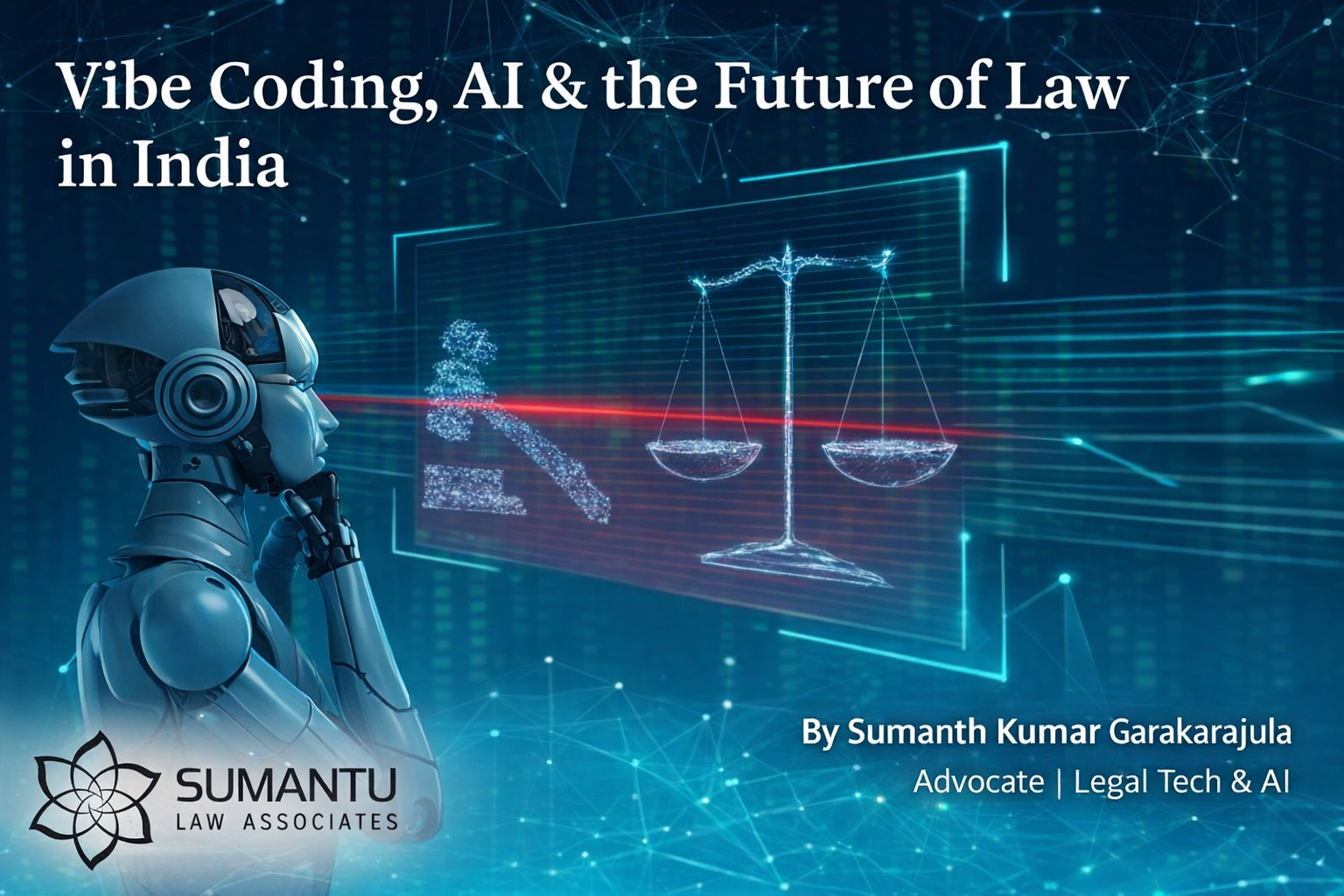
Artificial intelligence in law is no longer experimental in India. Courts, law firms, startups, and government institutions are already using AI for legal research, translation, transcription, case management, and document automation. As this adoption accelerates, a new development method—vibe coding—is quietly reshaping how legal software is built.
Vibe coding refers to creating applications primarily through natural-language prompts, allowing AI models to generate most of the underlying code with limited human review. While this approach promises speed and lower costs, its use in Indian legal technology raises serious legal, ethical, and constitutional questions.
What Is Vibe Coding in Legal Tech?
Vibe coding means describing legal workflows in plain language—such as “build an AI legal assistant” or “automate court filing compliance”—and relying on AI to convert those descriptions into functioning software.
In non-regulated industries, errors can be corrected later. In law, software errors may affect legal rights, limitation periods, confidentiality, and professional responsibility. This makes vibe coding especially risky in legal applications.
AI and Law in India: The Current Landscape
The Indian judiciary has cautiously embraced artificial intelligence as a supporting tool, not a decision-maker. AI systems are being used to:
- Translate judgments into Indian languages
- Summarise case records
- Assist with docket and case-flow management
Institutions like the Supreme Court of India have consistently emphasised that AI cannot replace judicial reasoning or human discretion.
This distinction is crucial. Vibe-coded legal systems often blur the line between assistance and decision-making—not by design, but by default.
Why Vibe Coding Is a High-Risk Model for Indian Legal Software
Indian law is deeply contextual. Concepts such as reasonableness, natural justice, and facts and circumstances cannot be reliably reduced to automated rules generated from prompts.
A vibe-coded system may:
- Apply generic legal logic unsuited to Indian statutes
- Ignore local procedural variations
- Fail to account for discretionary judicial standards
In the Indian legal landscape, efficiency cannot override fairness.
Unauthorized Practice of Law and AI Legal Tools in India
One of the most searched concerns around AI and law in India is whether legal chatbots and AI platforms amount to unauthorized practice of law.
Vibe-coded applications frequently:
- Collect user facts
- Apply legal rules
- Suggest legal outcomes or next steps
Without strict human-designed boundaries, such systems may cross ethical and statutory limits. Disclaimers alone are not sufficient. Design determines responsibility, not marketing language.
Data Protection, Privacy, and Legal Confidentiality
Legal AI systems process some of the most sensitive personal and commercial data in India. Poorly generated code may:
- Expose confidential client information
- Misconfigure access controls
- Transmit data to external APIs without safeguards
With India moving toward stronger digital governance norms, AI-generated legal software without security-by-design poses serious compliance risks.
Transparency and Explainability in the Indian Judiciary
Indian courts demand reasoned orders. Any system influencing legal decisions must be explainable.
Vibe-coded systems often lack:
- Clear logic trails
- Audit-ready documentation
- Deterministic reasoning
This opacity conflicts with the Indian judicial tradition, where reason is the foundation of legitimacy.
The Central Question Facing AI and Law in India
As AI adoption grows, the Indian legal system is implicitly asking:
Who is accountable when AI makes a legal error?
Vibe coding tempts institutions to shift responsibility to technology. Indian law does not permit this. Accountability always returns to human actors—lawyers, judges, officials, and institutions.
The Future of Legal Tech in India
Artificial intelligence will continue to shape Indian law. But sustainable innovation will depend on:
- Human-in-the-loop design
- Clear accountability frameworks
- Jurisdiction-specific compliance
- Transparent and explainable systems
Vibe coding may accelerate development, but it cannot replace legal judgment, ethical responsibility, or constitutional values.
Conclusion: Speed Must Follow the Rule of Law
The debate on AI and law in India is no longer theoretical. It is operational.
Vibe coding offers speed.
The Indian legal system demands care.
The future belongs not to the fastest legal software—but to systems that respect justice, accountability, and human judgment.
About the Author
Sumanth Kumar Garakarajula is an Advocate and legal-technology commentator, and the founder of Sumantu Law Associates. His work focuses on the intersection of law, artificial intelligence, and judicial governance, with particular attention to how emerging technologies reshape legal practice, professional responsibility, and access to justice in India. A former media professional, he regularly writes and speaks on AI in law, legal ethics, and the future of the Indian judiciary.
🔍