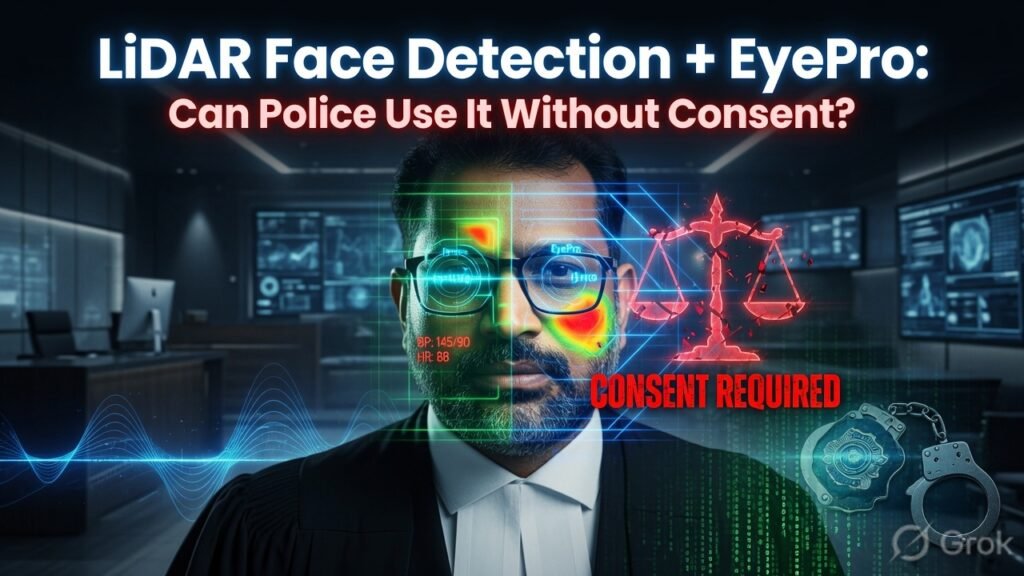
A courtroom in the near future does not need a confession. It needs a face. Feed a witness through a LiDAR scanner, layer facial recognition over the depth map, track the dilation of the pupil, the frequency of blinking, the micro tremor around the eye, and an algorithm will tell the judge, with a confidence score attached, whether the person is telling the truth. No wires taped to the chest, no injection, no polygraph operator reading a needle by hand. The subject may not even know the scan is happening. This is the promise being sold by a new generation of “non intrusive” lie detection systems, and it is worth asking, calmly and precisely, whether the promise is compatible with the Constitution, or whether it is simply the narcoanalysis test wearing a more comfortable coat.
Start with what has already been settled in India. In Selvi versus State of Karnataka in 2010, the Supreme Court held that narcoanalysis, polygraph examination, and the Brain Electrical Activation Profile test could not be administered on an accused, suspect, or witness without free and informed consent, and that even with consent the results could not be used as substantive evidence, only as a lead for further investigation if it produces independently verifiable material. The Court’s reasoning rested on two pillars: Article 20(3), which protects a person from being compelled to be a witness against themselves, and Article 21, read to include mental privacy and the right against non consensual intrusion into the mind. The judges were emphatic that the compulsory extraction of testimonial responses, whether verbal or physiological, from an unwilling mind amounts to testimonial compulsion, because the evidentiary value of these tests lies precisely in revealing information that the subject wishes to conceal.
The question a LiDAR based blink and pupil analysis system forces us to confront is whether it escapes this reasoning simply because there is no needle and no truth serum. The honest answer is that it should not. The constitutional objection in Selvi was never about the injection. It was about compelled access to involuntary physiological responses in order to draw a testimonial inference about guilt or deception. A LiDAR array reading a pupil is doing exactly that, only from a greater distance and with better optics. If anything, the absence of physical contact may make it more dangerous, not less, because it can be deployed covertly, in an interrogation room disguised as ordinary CCTV, or even in a public space, without the subject’s knowledge, and therefore without any occasion to assert the right to refuse.
Privacy law has already caught up with part of this concern, even if criminal procedure has not. The nine judge bench in Justice K S Puttaswamy versus Union of India in 2017 recognised informational privacy and bodily autonomy as facets of the right to life and personal liberty, and any biometric capture, facial mapping, pupil tracking, of a person without informed consent would need to satisfy the three fold test of legality, legitimate aim, and proportionality that the judgment laid down. A police station quietly running a facial and pupil scanner on every person who walks in to file a complaint would struggle to meet that standard, because the intrusion is broad, the aim is not narrowly defined, and the subject has no real opportunity to decline.
The comparative picture sharpens the point rather than softening it. In the United States, polygraph evidence has been treated with deep suspicion by courts since Frye versus United States in 1923, and the Employee Polygraph Protection Act of 1988 bars most private employers from even asking a worker to take one. The Fifth Amendment privilege against self incrimination and a growing body of state biometric privacy law, most notably Illinois’s Biometric Information Privacy Act, have already produced large litigation and settlements against companies that captured facial geometry without consent. A LiDAR pupil and blink detector sold to police departments would run into both bodies of law simultaneously, the evidentiary unreliability doctrine that has kept polygraphs out of most American courtrooms, and the biometric consent statutes that treat a faceprint the same way they treat a fingerprint.
Europe has gone further and drawn an explicit red line. The EU Artificial Intelligence Act prohibits, as an unacceptable risk practice, the use of AI systems to infer a person’s emotions from biometric data in workplaces and educational institutions, and treats biometric categorisation more broadly as high risk or outright banned depending on context. Regulators in Ireland and France are already enforcing this against employers who deployed facial and voice based mood detection tools, and the reasoning given, that these systems lack scientific reliability and are inherently intrusive to a person’s freedom of thought, tracks almost exactly the language the Indian Supreme Court used against narcoanalysis fifteen years earlier. Two very different legal traditions, the common law privacy tort tradition of the United States and the fundamental rights charter tradition of the European Union, have converged on the same instinct, that reading a body to infer a mind is not a neutral technical act.
None of this means LiDAR based deception detection is scientifically settled as reliable, and that is a separate and equally serious problem. Pupil dilation and blink rate are affected by lighting, fatigue, medication, anxiety unrelated to guilt, and neurological conditions, which is precisely the kind of unreliability that made Indian and American courts wary of the polygraph in the first place. A technology that adds a laser and a facial recognition layer to an already contested science does not become more admissible merely because it looks futuristic.
The honest conclusion, then, is that a non contact lie detector is not a loophole around Selvi, it is Selvi’s next test case. If the underlying purpose is to extract a testimonial inference of truth or deception from an unwilling subject’s involuntary bodily response, the method of extraction, chemical, electrical, or optical, should not change the constitutional answer. Any Indian legislation or police protocol that seeks to introduce this technology into investigation will have to reckon with informed consent, exclusion from evidentiary use beyond a lead, and a proportionality analysis under Article 21, or it will simply be narcoanalysis in a new uniform, waiting for its own day in the Supreme Court.